
De Pere City Directory Holdings
The strongest De Pere city directory shelf is at the Brown County Library Local History and Genealogy Department. Green Bay City and Brown County directory holdings include some runs from the 1870s. De Pere's historic-resources material specifically documents Green Bay City Directory coverage that includes De Pere from 1931 through 1958. Titles and publishers vary, so preserve the catalog record and title page with each result.
| Collection | Years | Where Held | Access |
|---|---|---|---|
| Green Bay City and Brown County directories | Some runs from the 1870s | Brown County Library Central | Library and catalog inquiry |
| Green Bay City Directory including De Pere | 1931-1958 | Library and city historic references | Local-history room |
| Federal Wisconsin census | 1820-1930; Brown County 1940 holdings | Brown County Library | Microfilm and databases |
| Wisconsin state census | 1855, 1875, 1885, 1895, 1905 | Library and archives | By collection |
| De Pere and Green Bay Sanborn maps | 1880s-1960s film; May 1895 online | Library and Library of Congress | Microfilm and digital sheets |
Start near a known event. A marriage, death, school year, deed, or news notice can narrow the shelf. Before the printed run, census and maps carry more weight. The 1890 federal population schedules were destroyed, but state schedules and local newspapers may bridge that gap. The 1905 Wisconsin census is valuable because it names each household member.
De Pere Directory Research Desk
Brown County Library's genealogy department began in 1974 and reports more than 10,000 print volumes and 4,400 microfilm reels. The room is on Central Library's second floor at 515 Pine Street in Green Bay. It opens 1 to 5 Monday, Tuesday, Thursday, and Friday, 1 to 8 Wednesday, and 1 to 4 Saturday. Staff offer research direction but do not conduct census searches for patrons.
Call 920-448-5815 or email bc.library.lhg@browncountywi.gov before a long visit. The Kress Family Branch at 333 N Broadway is a convenient De Pere contact, while the deeper collection is at Central. Remote databases may require a card, and copy rules depend on the source.
The library collection page shows the research setting used for De Pere city directory work.
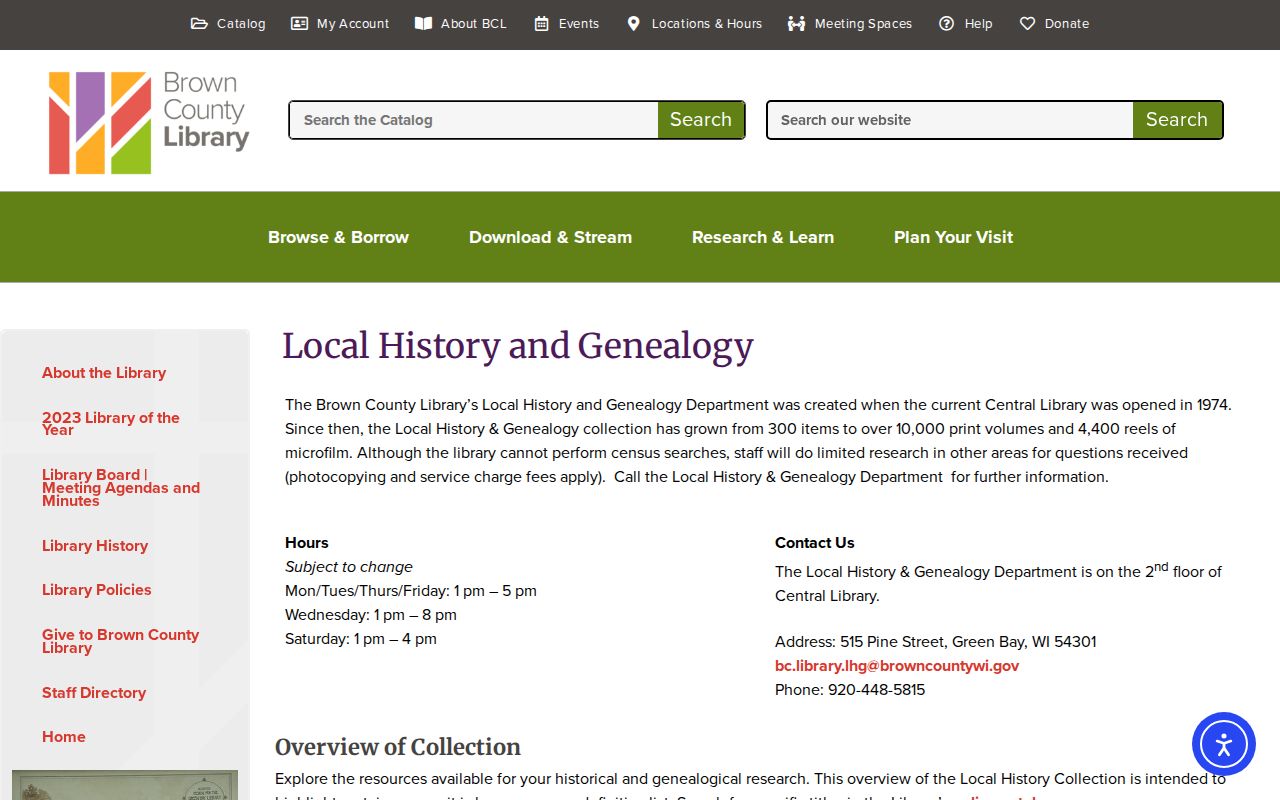
Its holdings list helps visitors plan which directories, films, maps, and surname files to request.
De Pere Directories From 1931
The 1931-1958 Green Bay City Directory run is the clearest printed sequence for De Pere. Search the surname list, save the entry exactly, then turn to the street or householder portion when an edition provides one. Repeat the search in the prior and next available years. A disappearance may signal a move, death, spelling change, missed edition, or a shift between De Pere and West De Pere wording.
Record the publication title, year, publisher, page, spelling, initials, street number, and cross-reference. City directories mix residents, businesses, institutions, and ads. Read the section label before treating a line as household evidence.
Reading De Pere Directory Entries
A useful city directory citation keeps more than a name. Save the given name or initials, spouse notation, printed work or business description, address, telephone or boarding mark, and each “see” reference. Note whether it came from the alphabetical list, street index, classified pages, or an ad.
| Name | Exact surname, given name, initials, and spouse notation |
|---|---|
| Printed role | Occupation or business wording in that edition |
| Address | Street form, house number, and householder or boarding mark |
| Code | Telephone or symbol defined in the book's key |
| Reference | “See” entry, business listing, or removal note |
- Criss-cross directory
- A volume arranged by street and number so an address leads to a printed occupant.
- Householder index
- An address list naming the principal occupant identified by that edition.
- Abbreviation key
- The publisher's legend for short forms, work codes, spouse marks, and residence symbols.
A line proves only what the publisher printed for that year. Confirm it in a second edition and pair it with a dated census, newspaper, parcel, or deed record.
De Pere and West De Pere
Place names changed as local government developed. De Pere served as Brown County's seat from 1837 to 1854. The Village of De Pere incorporated in 1857, West De Pere in 1870, and the City of De Pere in 1883. An older directory or news item may file a family under a west-bank label, township, addition, or modern city name.
Search Dickinson's Addition when a legal description points there. Randall and Michigan-Superior also retain the resident-used historic names Urbandale and Irwin. These terms can unlock plats, directory lines, and notices that a modern street-only search misses.
De Pere Directory Maps
The 1875 Brown County atlas supplies place and business context, including a West De Pere illustration for W.A. Bingham & Co. The May 1895 De Pere Sanborn set has 12 sheets showing footprints and mapped uses. Together they test whether an address referred to a home, store, shop, church, or school.
The digitized atlas provides a visual check for De Pere city directory findings.
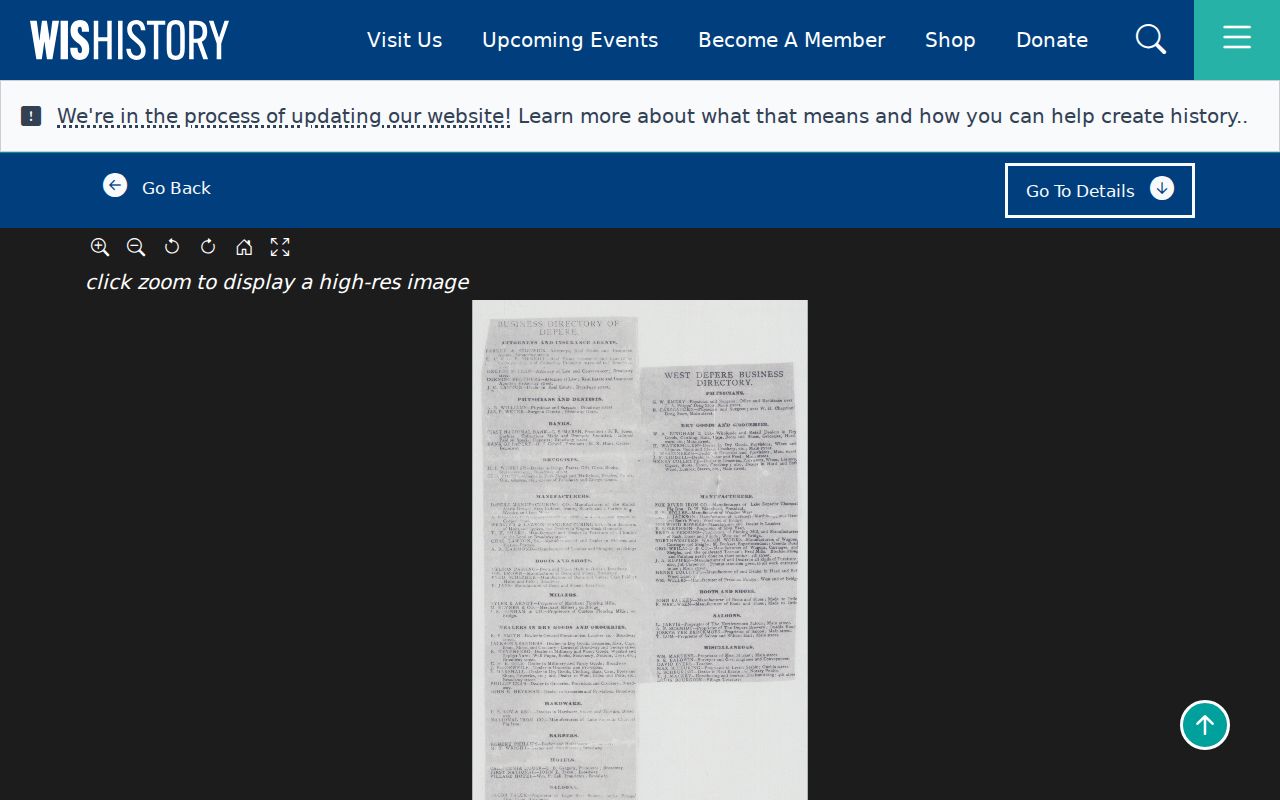
Save the sheet or page with the directory citation. Building use can change while a street number stays the same.
De Pere Directory Names in Newspapers
Newspapers can explain a gap between editions. Brown County Library lists the Green Bay Press-Gazette from January 29, 1915 to near its current update, Gazette material from 1870 to June 28, 1915, and the Advocate from 1877 to 1885. The De Pere Journal is listed for March 10, 2005 through February 27, 2014, and Compass for March 4, 2005 through June 30, 2023. Access varies and may require a library card.
Dutch-language papers are a rare De Pere source for spelling and family networks. Onze Standaard runs from January 18, 1878 to August 1907, with the De Pere Standaard title variant documented for 1878-1894. Volksstem covers March 14, 1890 to July 1, 1919. Search surname variants with church, obituary, association, and migration terms.
Trace De Pere Directory Families
City directories work best as a sequence. Build a year log and leave blanks where no edition is held. Then connect it to census, cemetery, vital, and newspaper sources. Brown County Library holds federal Wisconsin census material from 1820 through 1930 and Brown County material for 1940, plus state and territorial schedules. The De Pere resident lookup can test a later name against official indexes without treating an old entry as current.
- Begin with the edition nearest a known dated event.
- Search the surname, initials, spouse name, and spelling variants.
- Move backward and forward through nearby editions.
- Pair the entry with federal or Wisconsin census years.
- Confirm a move, death, or address change in another record.
Some residents were omitted and publication could lag. Boarders and adult children may not appear. Never force a similar name into a household when age, place, or date conflicts.
De Pere Directory Archives
The De Pere Historical Society, UW-Green Bay Archives and Area Research Center, and Wisconsin Historical Society De Pere search extend the trail. The inspected WHS view returned 1,009 Brown County results filtered to De Pere, including historic property records, addresses, architecture, and survey notes.
A September 2025 report described records, newspapers, and yearbooks spread across seven locations while six to eight volunteers digitized them. Ask whether material has been processed or moved to the Heritage Center. A current collection inquiry may reveal more than a static catalog.
Archive tip. Give a surname, date range, address or addition name, and record type instead of requesting everything about a family.